

Is Market Concentration a Real Threat to Your Retirement Portfolio?
KEY TAKEAWAYS:
- The largest US companies make up a disproportionate share of the US stock market, but similar levels have occurred throughout history.
- Changing your long-term investment strategy in response to market concentration may be counterproductive.
- A globally diversified retirement portfolio dramatically reduces the exposure to small groups of stocks dominating single market indexes.
Did you know that as of July 2026, the top 10 stocks in the US stock market accounted for about 35% of its value? So for every $1 invested in a market-cap-weighted US total market index fund, such as Vanguard Total Stock Market (ticker: VTI), $0.35 is funneled back to just those 10 companies. That concentration increases to roughly 38% in less-diversified S&P 500 funds, such as Vanguard’s VOO ETF.
If you use index funds as part of your investment portfolio for retirement, numbers like these can raise an uncomfortable question: has your portfolio become too risky due to a lack of diversification?
To add to the worry, this “market concentration” narrative has been fully embraced by the financial media, which claims that investors are setting themselves up for a world of hurt by investing in index funds disproportionately comprised of just a handful of technology companies. Their solution? Tactical changes to your long-term investment strategy to prevent this ticking time bomb from blowing up your retirement plan.
It’s true that stock market concentration is high. But as retirement planning specialists, we believe these concerns are overblown, and this kind of concentration is not a reason to abandon a long-term strategy.
Market Concentration Isn't New — Here's the History
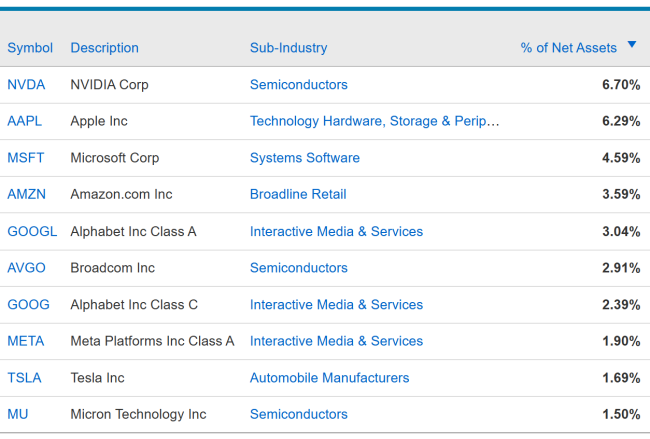
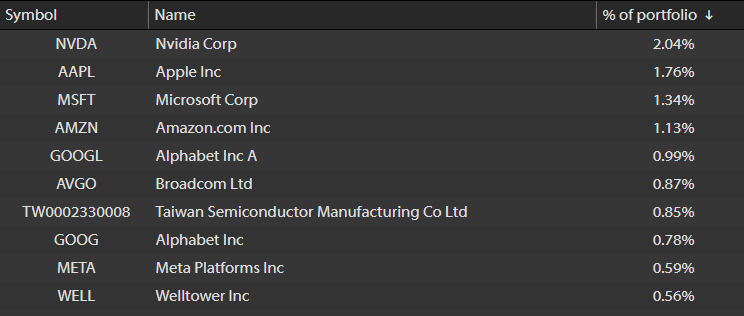
As we’ve mentioned, the top 10 holdings in the US stock market today account for more than a third of the total market share. Here’s a list showing exactly what those stocks are:
Top 10 Holdings in Vanguard US Total Stock Market Fund
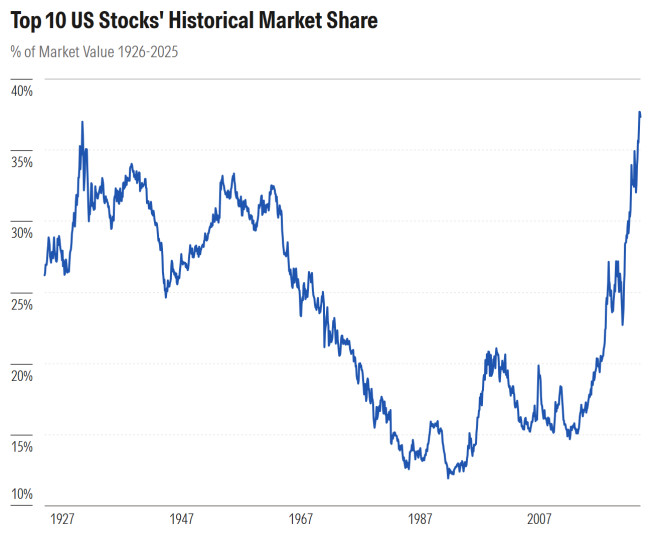
If we look at the history of the market, we’ll find that market concentration is a feature of the US Stock Market that is in constant flux. Yes, we are currently flirting with historical highs. But although that’s the case, Morningstar notes that high concentration was the norm between the 1920s and 1960s, exceeding 30% during several periods, so it’s not unprecedented.
So what should you do about this market concentration - if anything?
What the Financial Media Gets Wrong About Market Concentration
The common narrative is that these historically high market concentrations are risky for index fund investors and require action to avoid having too much invested in too few stocks. And to reduce your risk, you must alter your investment plan to include investments such as “equal-weighted”, value stock, or private equity funds to increase diversification, or perhaps reduce your stock exposure altogether.
But counterintuitively, the data suggests that trying to avoid concentration can backfire, increasing risk and lowering returns.
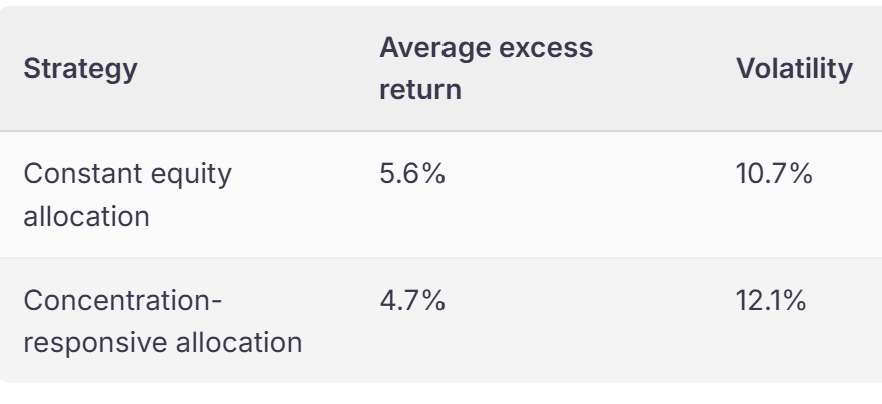
In the paper "Fallacy of Concentration," authors Mark Kritzman and David Turkington tested whether market concentration has historically increased investor risk and whether taking measures to avoid concentration is beneficial. To do this, they used US stock market data spanning from 1926 to 2025 and compared a buy-and-hold strategy (Constant Equity) with a dynamic strategy (Concentration-Responsive) that reduced stock holdings during periods of high market concentration.
Their conclusion: “…investing less in the stock market when it is more concentrated reduces return and increases risk compared to the buy-and-hold strategy that allows concentration to evolve naturally.” They added that the buy-and-hold strategy produced more than twice as much ending wealth as the dynamic strategy, and that stock market concentration levels had no predictive power of future returns.
Buy and Hold Versus Reducing Stocks When Concentration Rises
Where Size, Quality, and Sectors Come In
It’s also worth remembering that diversification stretches beyond the number of stocks you own. A portfolio with fewer but larger stocks may seem less diversified, but it may offer more diversification than owning a larger number of smaller-company stocks. This is because those larger, modern companies have greater economic diversification through their expansive business models and revenue streams spanning products and countries.
An extreme example is comparing Amazon (one of the ten largest companies in the S&P 500), with its numerous subsidiaries across various sectors, to Chitpole Mexican Grill (one of the ten smallest companies in the S&P 500), which relies solely on selling fast food. The benefits of economic diversification may be reflected in the historically lower volatility (a proxy for risk) of large-company stocks compared to smaller companies.
"Trying to sidestep market concentration by making changes to your portfolio sounds prudent, but the data shows it reduces returns and increases risk. The best response to concentration headlines is having a well-built and diversified portfolio." - Michael Nemick, CFP®
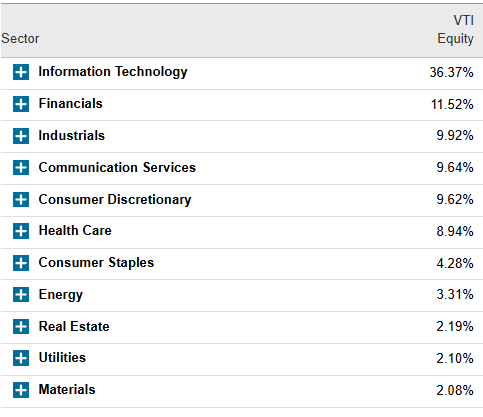
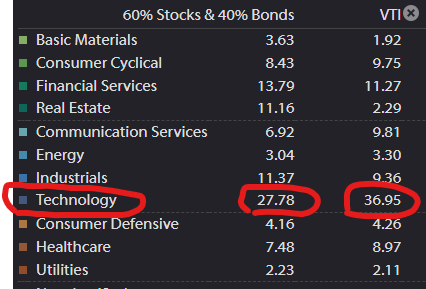
Economic diversification is also helpful to consider when evaluating exposure to other dimensions of concentration, such as sector concentration. After all, Technology now represents roughly 36% of the US stock market which is near historical extremes. But just like individual stock concentration, a link between sector concentration and increased market risk hasn’t been found. While this may seem counterintuitive, keep in mind that a sector label is an incomplete description of a company’s business and economic risk factors.
Sector Weights of Vanguard US Total Stock Market Fund
The Missing Context: Your Full Retirement Portfolio
A glaring omission in the conversation about index fund market concentration is how it looks in the context of a diversified retirement portfolio. After all, we don’t know too many retirees who allocate their entire portfolio to a US stock market fund.
Using the classic 60% stocks and 40% bonds portfolio as an example, we see that the top ten holdings make up less than 11% of the investment portfolio compared to 35% and 38% when viewing the US Total Stock Market and S&P 500 Funds in isolation, respectively—a dramatic difference.
Top 10 Holdings of a Globally Diversified 60% Stocks & 40% Bonds Portfolio
With a portfolio that’s well-diversified between stocks and bonds, we also see that stock sector diversification improves. As we can see below, the amount allocated to Technology has decreased by nearly 10%, which is due to the different sectors that dominate international markets.
Stock Sectors: Globally Diversified 60% Stocks & 40% Bonds Portfolio Vs. Vanguard Total Stock Market
Although market concentration has historically benefited investors, it doesn’t mean that it can never increase risk, so it’s crucial to build a globally diversified investment portfolio to help manage that risk through retirement.
Market concentration is worth monitoring, but it shouldn’t be the only factor influencing portfolio decisions. In addition, it’s just a subcomponent of one of many risks retirees face. We cover the Big Five Retirement Risks Every Retiree Faces here.
A goal of retirement planning is to identify each retiree's risk exposures and create a framework for long-term strategic decisions, rather than making changes based on headlines alone.
As retirement planning specialists, we help clients build globally diversified, personalized portfolios designed to weather shifts in market concentration while supporting their long-term income needs. If you're approaching retirement — or already in it — and want a clear assessment of whether your portfolio is truly as diversified as you think, we'd be happy to help. Click here to schedule a complimentary call with one of our retirement planning specialists.
Frequently Asked Questions
What is market concentration?
Market concentration refers to the distribution of market value across holdings, such as individual stocks, sectors, or industries.
Should I sell my index funds because of market concentration?
For most long-term investors, no. Research covering nearly 100 years of market data found that reducing stock exposure during periods of high concentration lowered returns and increased risk compared to simply staying invested.
How can I reduce concentration risk in my retirement portfolio?
The most effective approach is global diversification. In a classic 60/40 portfolio that includes international stocks and bonds, the top 10 US stocks make up less than 11% of the total — versus 35–38% in a US-only stock fund.
Is high market concentration a sign of a market bubble?
Not necessarily. Concentration levels have historically had no predictive power over future returns. High concentration reflects the size of today's largest companies, not necessarily their overvaluation.