

Why Higher Returns Don’t Necessarily Mean Higher Retirement Income
KEY TAKEAWAYS:
- Chasing higher investment growth can unintentionally reduce your spending capacity during the early, most active years of retirement, especially if markets decline soon after you retire.
- A more conservative portfolio can provide steadier spending and may outperform stock-heavy portfolios in supporting near-term retirement goals.
- Effective retirement planning starts with clarifying goals and designing a spending plan first, then selecting an investment strategy that best supports those priorities—rather than letting growth ambitions drive the plan.
It’s logical to assume that as your investments grow, you will have more money to spend in retirement. And because it’s impossible to determine exactly how much income you will need to support a multi-decade retirement, prioritizing investment growth seems right since it’s better to have more than needed than not enough.
As retirement planning specialists, we notice that this preference for growth can lead to a reluctance to adopt a more conservative investment strategy as retirement approaches. The problem is that this may actually decrease your retirement spending capacity during your "go-go years", when it matters most.
To avoid unintentionally jeopardizing your retirement plans, you are better off following a retirement income planning process focused on identifying an investment portfolio that maximizes the chance of funding your goals, rather than merely concentrating on achieving high investment growth.
Why Retirees Chase Higher Returns With a More Aggressive Portfolio
Healthcare costs, inflation, long-term care expenses, and investment returns are among the financial unknowns that can cause stress and anxiety for retirees. As a cure, we too often see people wanting to stick with the stock-heavy investment portfolio they used during their working years as they enter the decumulation stage of retirement.
The thinking goes that the greater the investment growth, the more money they can spend during retirement, allowing them to fund their spending goals while also providing a bigger buffer against uncertainties.
While it's true that a portfolio with higher investment returns offers greater spending upside than a lower-growth portfolio, this approach can result in a retirement income plan that calls for less spending during the early years of retirement than a plan that uses a more conservative investment strategy.
Illustrating the Risk of Retiring with a More Aggressive Portfolio
To emphasize this point made above, the above graph below uses historical returns to compare a retiree's spending capacity for an 80% Stocks and 20% Bonds portfolio and a 60% Stocks and 40% Bonds portfolio if they had the bad luck of retiring shortly before the Global Financial Crisis.
GRAPH 1: SPENDING CAPACITY: 80% STOCKS & 20% BONDS VS. 60% STOCKS & 40% BONDS

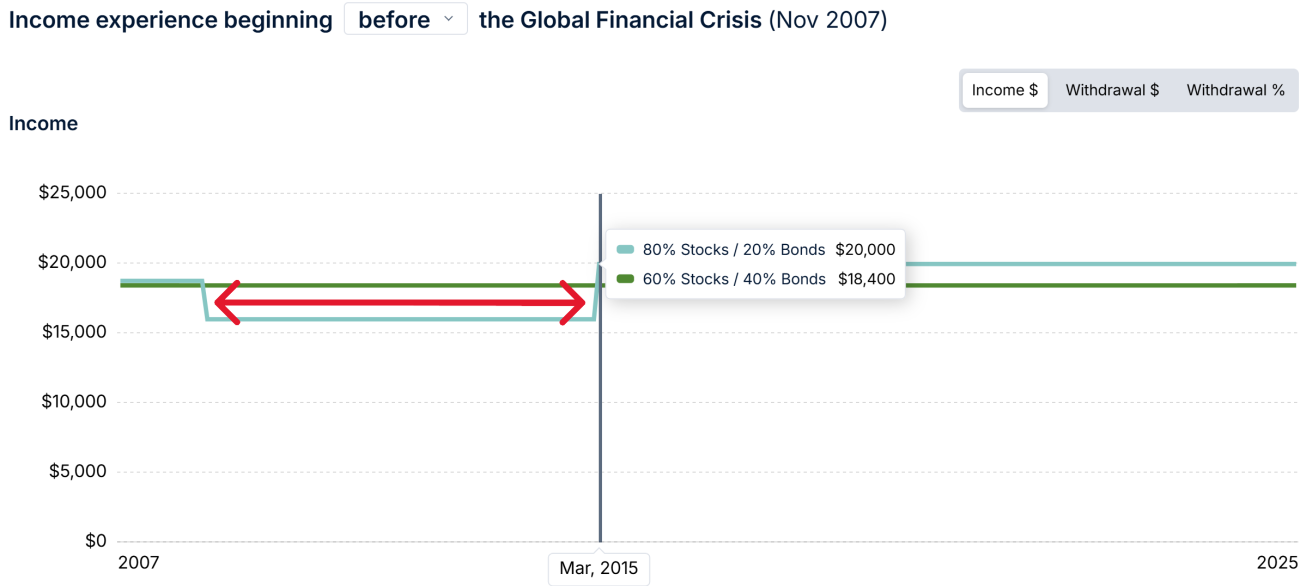
The spending capacity is $18,400 for both portfolios at the start of retirement. But as the market selloff ensues in early 2009, the spending capacity for the 80% stock portfolio drops to $16,000 per month – almost $30,000 less per year than the 60% stock portfolio! That reduction continues for nearly 7 years, after which the 80% stock portfolio eventually recovers.
Although the higher returns of the 80% stock portfolio ultimately led to greater spending capacity, it came at the cost of a sizeable reduction in spending during the go-go years. This runs counter to what many of our clients desire when asking for retirement advice: maximizing spending in early retirement while they still have their health and energy to pursue their interests.
GRAPH 2: REDUCED SPENDING CAPACITY DURING THE “GO-GO” YEARS
A Proper Retirement Planning Process Can Help Reduce Risk
The risk of retiring into a bad market, such as the one illustrated above, is called the sequence of returns risk. But having a thoughtful retirement planning process in place can help you avoid unintended consequences by focusing on the right things in the right order.
The first step is to get clear on your goals and priorities and develop a spending plan to make them happen. From there, you can identify the appropriate investment strategies for your plan. For example, are you prioritizing maximizing spending early in retirement or leaving a legacy?
A moderate-growth portfolio with moderate volatility may be better for the former, whereas a higher-growth portfolio with high volatility may be better for the latter. The key is to choose an investment strategy that serves your goals, not the other way around.
Don’t Let Financial Markets Dictate Your Lifestyle
The aim of retirement planning isn’t to win an investment race—it’s to create a life you can enjoy with confidence. By aligning your portfolio with a well-defined set of goals and priorities, you set yourself up to spend more freely when it matters most and reduce the risk that financial markets dictate your lifestyle.
If you’d like help building an investment portfolio that best positions you for a fulfilling retirement on your own terms, you can schedule a call with one of our retirement planning specialists here to get started.