


How Long Can Market Downturns Last in Retirement? (And How to Plan for Them)
KEY TAKEWAYS:
- Market downturns are inevitable during a long retirement, so having a plan in place ahead of time is key to avoiding emotional and costly decisions.
- Sequence of returns risk means selling assets at a steep loss in retirement can have a lasting impact, making timing just as important as long-term returns.
- A well-structured income strategy can help you fund your lifestyle during volatility without needing to sell investments at the wrong time.
Bad markets or moments of market downturns don’t seem so bad…when you’re young. But when you’re in the retirement planning phase—or already in retirement—every day the market is down can feel much more stressful.
One of the main reasons for this is that it requires a completely different mindset. As retirement planning specialists, we often see that this shift is where many investors begin to feel the real impact of what’s known as sequence of returns risk.
It’s just so much easier as a young person investing money for retirement. As an accumulator, you make regular contributions and ride the market’s ups and downs without a care in the world. Markets go up, you feel great watching your nest egg grow. Markets go down, you take solace that your regular contributions are buying in at a great time—and that markets will bounce back along with the value of your investments well before you need the money to fund your lifestyle. That shift—from contributing to your portfolio to relying on it—is where everything starts to change.
From Accumulation to Decumulation: Why Retirement Changes How You Experience Market Downturns
One of the trickiest transitions one has to make as they prepare for retirement, is switching from an accumulation mindset to a decumulation mindset. In retirement, you now need to sell investments periodically so distributions can be made to support ongoing living expenses.
You can no longer turn a blind eye to market downturns as you once could while accumulating. And not only do declines feel more stressful, but they can also have a much more meaningful impact on your long-term plan.
As retirement planning specialists, this is where we see a key risk emerge: Sequence of Returns Risk (SoRR).
SoRR is the danger that poor investment returns (especially earlier in retirement), combined with ongoing withdrawals, can permanently reduce how long a portfolio lasts.
Tools to Protect Your Retirement Income from Sequence of Returns Risk
During the course of a retirement that could last 30 years or more, experiencing multiple market downturns and corrections should not come as a surprise.
You need to have a plan that details how you can continue funding your regular monthly spending needs without being forced to go into your investment portfolio to sell assets while they are down steeply in value. The good news is there are several tools that can help protect your retirement income during periods of market volatility.
Rather than relying on a single solution, we often think in terms of layers of protection—each designed to give you flexibility and time.
Here are some of the possible risk management tools that can create layers of defense:
- First layer of defense is an income ladder built with Treasuries or CD’s
- Second layer of defense is savings buffer (perhaps combined with reduced spending)
- Third layer of defense is HELOC/PAL (i.e., line of credit) availability
- Last layer is funding from bonds and letting the portfolio’s stock allocation drift higher if necessary
The common theme among these tools is they each allow a retiree to continue funding current living expenses without having to sell assets during a market downturn. Each individual’s unique preferences, resources, and risk tolerances will guide which tools to use and to what extent.
Learn more about how to use these and other tools to protect yourself from retirement risks in our Insight entitled "How to Use Liquidity to Protect Yourself from Retirement Risks."
The goal is to have a plan in place that can allow you to ride out (or mostly ride out) a “worst case” scenario. What should you realistically plan for as a “worst case” scenario?
What Could a “Worst Case” Scenario Look Like?
Many people planning for retirement wonder how often market downturns happen and how long bad markets can actually last. Since 1929—nearly 100 years— the S&P 500 logged a correction of 10% or more 56 times according to a Reuters analysis of data from Yardeni Research. Excluding corrections that became bear markets (defined as a drop of 20% or more), the average correction resulted in a peak to trough (or bottom) decline of 13.8% and lasted 115 days.
When it comes to managing SoRR, it is length of time that matters more than decline in value because the goal is to allow time for markets to rebound before having to sell, whatever the price decline.
Following is some data on 13 major bear markets, where prices declined by more than 20%, in the U.S.:
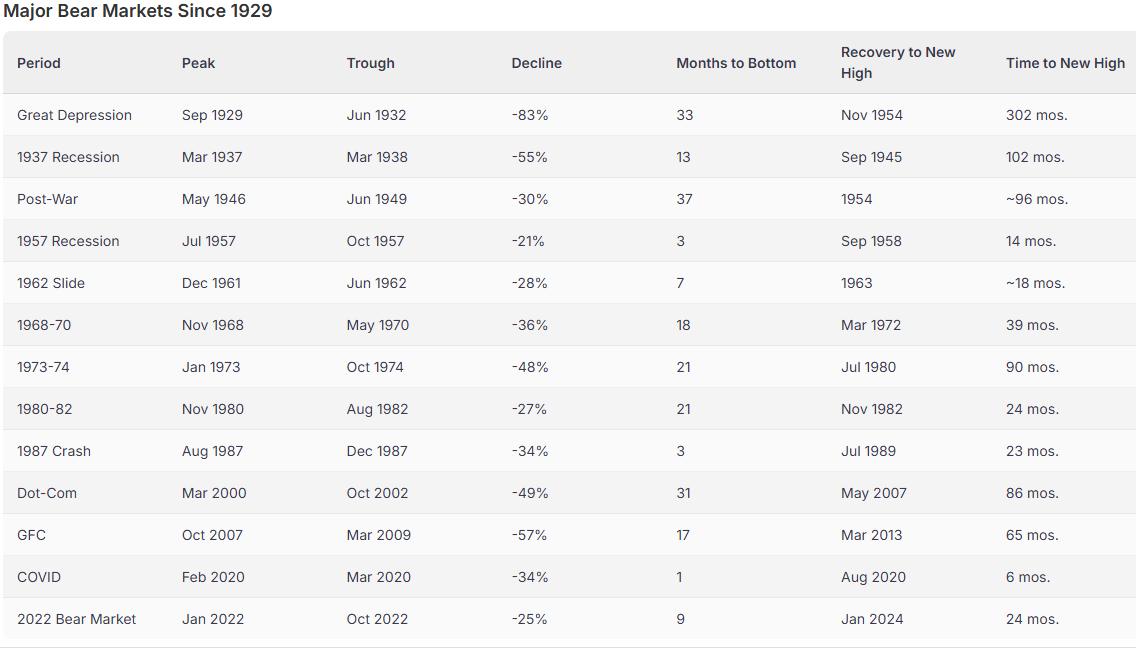
Excluding the Great Depression, the average bear market took 16 months to go from a peak to a trough and another 33 months beyond that to reach fresh highs. That means the average bear market, excluding the Great Depression, took an average of four years to go from a peak, to a trough, to a new peak again.
We exclude the Great Depression from our averages because its roughly 25-year peak-to-trough-to-recovery timeline makes it a clear outlier. Also, recoveries tend to happen faster today than they did before, as policymakers now tend to respond much faster (and more correctly after lessons learned from the Great Depression) with interest rate cuts, liquidity support, and fiscal stimulus. We also have stronger banking protections, better economic data, and faster communication, which can help stabilize confidence more quickly.
Of course, none of us know what could happen in the future, but an understanding of the past can help us form a reasonable idea of how long a “worst-case” market event could last.
Don’t Forget To Diversify
While the data on the S&P 500 is valuable, it is important to recall that the S&P 500 is designed to only measure a single asset class: U.S. Stocks. A diversified investment portfolio that adds international stocks and bonds to U.S. stocks will likely drop less and recover more quickly than an investment in U.S. stocks alone, creating a smoother overall investment experience.
Learn more about How to Build Your Optimal Investment Portfolio for Retirement here.
Putting It All Together to Optimize Your Retirement Plan
With a reasonable definition of a “worst-case” market event in mind, a retiree can begin to build a proactive SoRR management plan by stacking the appropriate layers of defense and using them in a way that is congruent with their preferences, resources, and risk tolerances.
For instance, a more risk-averse retiree without a large savings buffer (and/or the ability to reduce spending) may feel more comfortable building a four- to five-year income ladder instead of relying on short-term borrowing or letting their portfolio take on more risk while waiting for markets to recover.
On the other hand, another retiree might find the idea of sitting on five years worth of living expenses in cash just in case a “worst-case” scenario happens intolerable. This individual might instead choose to build a two year income ladder and then lean on the other layers of defense if and when needed. There is no one-size-fits-all solution that is right for everyone.
Market downturns are a natural part of investing. But the impact they have on your plan depends largely on how prepared you are going into them.
As retirement planning specialists, we help clients build thoughtful, personalized strategies designed to navigate market uncertainty while supporting long-term income needs. If you’re approaching retirement—or already in it—and want to ensure your plan is positioned to handle market volatility, we’d be happy to help you think through your options. Click here to schedule a complimentary call with one of our retirement planning specialists.